
Explore Off-Plan Projects
Stay in the loop Through our newsletter
Get to know about the latest real estate insights.

Next Level © 2026 All Right Reserved
Stay in the loop Through our newsletter
Get to know about the latest real estate insights.
Next Level © 2026 All Right Reserved
No tags available
Quick answer: Wellness real estate means homes and communities designed to actively improve residents' physical and mental health. The Global Wellness Institute (GWI) valued the global market at $876 billion in 2025 and forecasts $1.8 trillion by 2030. The UAE market reached about $14.6 billion in 2025, and Dubai is the regional hub, led by master-planned communities such as Dubai Hills Estate, Sobha Hartland, Tilal Al Ghaf, Expo City Dubai, Ghaf Woods and Keturah Reserve. GWI research shows wellness-focused homes at the middle and upper end of the market sell at a 10 to 25% premium.
For decades, Dubai property was sold on views, brand names and square footage. In 2026, a different question is shaping how buyers choose a home: will this place help me live a healthier life? Developers are answering with forests instead of car parks, cycling loops instead of service roads, and homes specified for air, light and water quality. This guide explains what is driving the trend, where it is happening in Dubai, what the latest transaction data says, and how to judge whether a "wellness" label is worth paying for.
GWI defines wellness real estate as homes and buildings proactively designed and built to support the holistic health of their residents. The key word is proactively. A gym and a pool are amenities; a wellness home is planned from the masterplan down to the materials so that healthy behaviour becomes the easy default.
In Dubai, genuine wellness real estate usually combines three layers:
The home: filtered fresh air, purified water, generous daylight, acoustic comfort, low-toxicity finishes and natural materials. Our guide on keeping indoor air quality healthy explains why this matters in a climate where residents spend most of the summer indoors.
The community: parks, shaded walking and cycling routes, water features, sports facilities, schools and clinics within a short walk, and spaces that encourage neighbours to meet.
The city: public policy that adds green space, transit and walkable neighbourhoods, which Dubai is actively funding through its long-term urban plans.
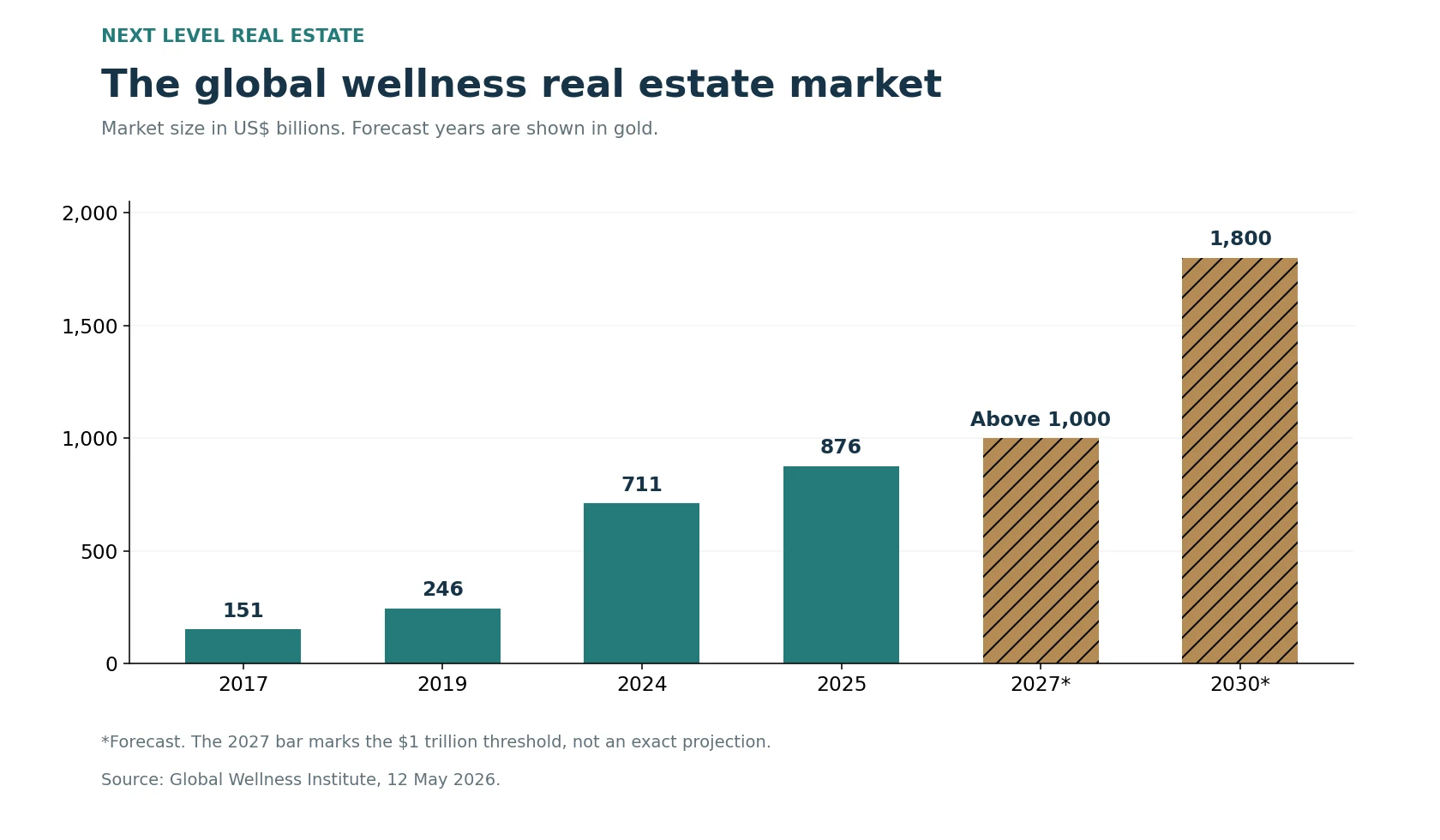
On 12 May 2026, GWI released updated data showing that wellness real estate remains by far the fastest growing segment of the global wellness economy. The figures below come directly from that release.
| Year | Market size | What it shows |
|---|---|---|
| 2017 | $151 billion | Early niche, mostly luxury and resort-linked projects |
| 2019 | $246 billion | Pre-pandemic baseline |
| 2024 | $711 billion | Post-pandemic acceleration |
| 2025 | $876 billion | 23% growth in one year, against about 3% for global construction |
| 2027 (forecast) | Above $1 trillion | First year above the trillion mark |
| 2030 (forecast) | $1.8 trillion | About 15% average annual growth from 2025 |
What this means for buyers and investors: when one segment grows at roughly 23% a year while construction overall grows at 3%, capital and buyer demand are moving toward it. Developers follow that money, which is why so many recent Dubai launches lead with nature, health and longevity messaging. The opportunity is real, but so is the risk of paying a premium for marketing rather than substance.
A note on the numbers: GWI revised its historical series in 2026, so older articles quoting $584 billion for 2024 and $1.1 trillion for 2029 are based on the previous methodology. The current figures above supersede them.
GWI's regional data shows the Middle East and North Africa market rising from $8.7 billion in 2019 to $42.6 billion in 2025, an average of 30.3% a year, one of the fastest regional growth rates globally. Saudi Arabia reached $28 billion with about 34% annual growth, while the UAE reached roughly $15 billion with about 25% annual growth over 2019 to 2025.
Two further GWI findings stand out for the Gulf:
Across the UAE and Saudi Arabia, wellness real estate now represents more than 12% of all construction, compared with a much smaller share globally.
More than 555,000 wellness-focused residential units are planned or under way across the two countries.
What this means: the Gulf is not following the global trend; it is one of the places setting it. For Dubai buyers, the 555,000-unit pipeline is also a reminder that supply is coming. Over the next five years, the communities that hold value will be the ones where wellness is built into the masterplan, not printed on the brochure.
Dubai's government has made quality of life an explicit planning goal, which gives wellness-led communities long-term tailwinds that pure marketing cannot.
Dubai 2040 Urban Master Plan: commits to doubling green and recreational space and increasing land for health and education facilities. Read our breakdown of the Dubai 2040 Urban Master Plan and its sustainability goals.
Dubai Quality of Life Strategy 2033: approved in May 2024 with more than 200 projects, including the "20-minute city" goal that 80% of daily needs should be reachable within a 20-minute walk or ride, and an expansion of public park area from 23 to 64 square kilometres.
Green building rules: Dubai's building regulations increasingly require energy, water and indoor environment performance. Our developer guide to Dubai green building regulations covers what is now mandatory.
Why it matters for investors: public investment in parks, transit and walkability around a community supports demand and pricing over the long term. When choosing between two similar projects, the one aligned with a planned park corridor or metro extension carries less risk.
A YouGov survey of more than 1,000 UAE residents, commissioned by developer R.Evolution and reported by Gulf News in May 2025, found that 9 in 10 residents see a healthy home environment as a top priority. 92% rated indoor air quality as extremely or very important, 93% said the same about purified water, and more than 80% said they would pay extra for homes designed to support wellbeing.
From what we see with clients, the priorities split by buyer type:
Families prioritise parks, safe cycling, schools within walking distance and low traffic streets.
High-net-worth relocators look for privacy, nature views, spa and longevity facilities, and low-density planning.
Professionals and couples want walkability, a fitness culture on the doorstep and good air and light in an apartment.
Investors want all of the above to translate into tenant demand, lower vacancy and resale liquidity.
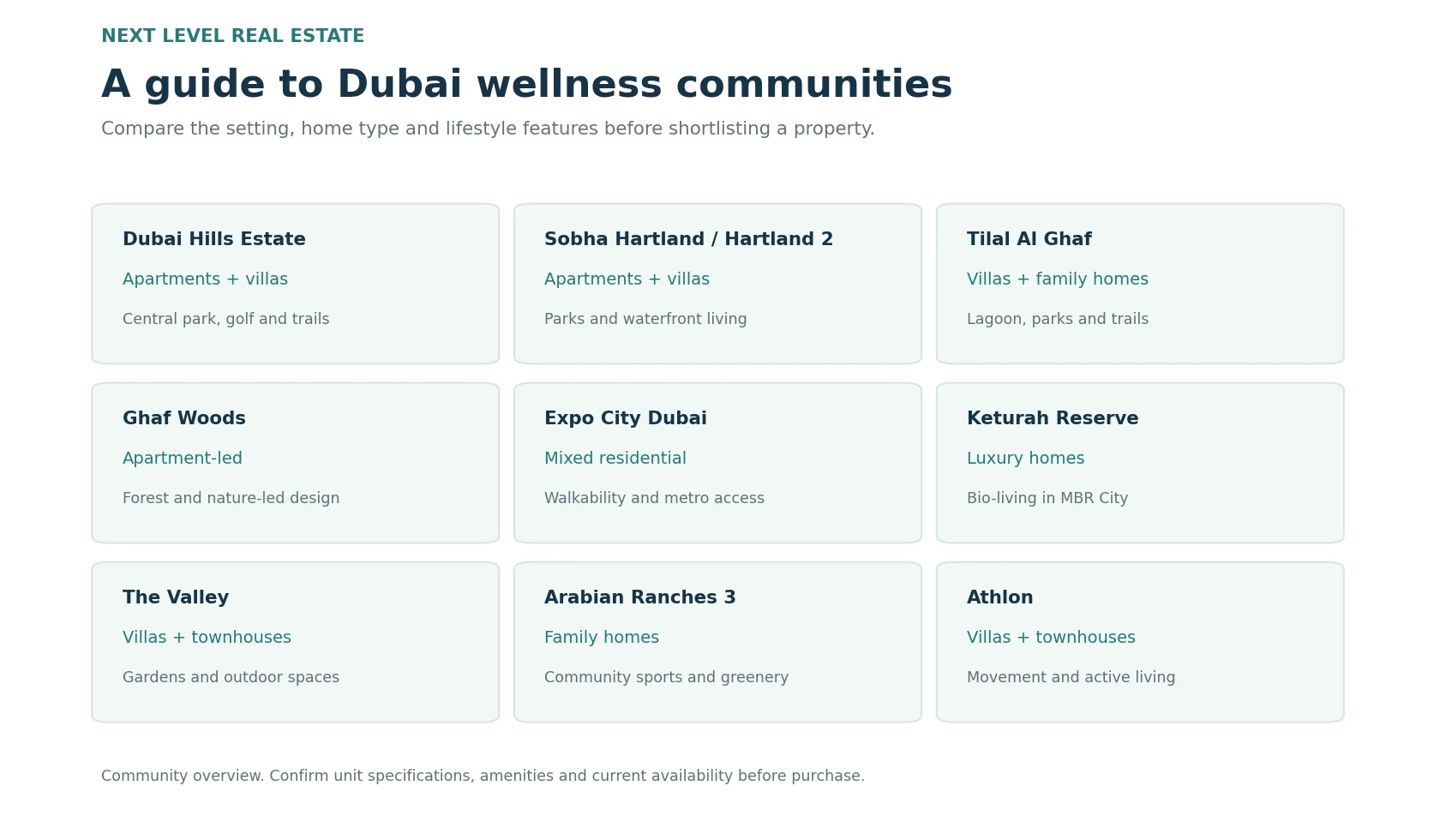
Emaar's Dubai Hills Estate is the benchmark for suburban wellness in Dubai, built around a central park, an 18-hole golf course, long jogging and cycling tracks and a hospital inside the community. It is also one of the most liquid wellness markets in the city, with strong resale activity across villas in Dubai Hills Estate and apartments. Its proximity to Downtown Dubai is a major part of its premium.
Set in Mohammed Bin Rashid Al Maktoum City, Sobha Hartland combines lagoons, landscaped parks, international schools and waterfront promenades minutes from Downtown. Buyers can browse villas for sale in Sobha Hartland or read our complete guide to living in Sobha Hartland. Further out, Sobha Realty is extending the same nature-led approach to Dubailand through projects such as Sobha Elwood and its AED 50 billion Sobha Sanctuary masterplan off Al Ain Road.
Majid Al Futtaim's Tilal Al Ghaf is organised around a swimmable lagoon with a sandy beach, surrounded by parks and trails. The community attracts families looking for a resort lifestyle without leaving the city, and the most popular options are its villas and family homes in Tilal Al Ghaf.
GWI selected Ghaf Woods in Dubailand as a featured case study in its 2026 research. The 182-acre community includes an 18.7-acre forest and about 5,000 mid and high-rise apartments. GWI's takeaway from the project is direct: strong demand makes wellness real estate a market differentiator and a profit driver. It is also one of the rare wellness communities where buyers can enter at apartment price points rather than villa budgets, under the master developer Majid Al Futtaim.
The former Expo 2020 site is another GWI case study: 865 acres with 74 acres of open space, planned for around 35,000 residents and 40,000 workers. GWI highlights how nature, culture and heritage give the district a strong sense of place. Residential launches such as Al Waha Signature Residences at Expo City Dubai sit within walking distance of parks and existing metro infrastructure.
Keturah Reserve by MAG Lifestyle Development is an AED 5.7 billion bio-living community in District 7 of MBR City, positioned firmly at the ultra-luxury end of the wellness market. We have covered why international buyers are choosing Keturah Reserve in detail.
For buyers who want a garden, outdoor space and community sports at a lower entry price, Dubai's outer suburbs are where wellness planning is most affordable. Emaar's The Valley on Al Ain Road offers off-plan villas in The Valley, while established family buyers often compare it with villas in Arabian Ranches 3. Aldar's movement-focused Athlon in Dubailand is built around running loops and active lifestyle facilities.
At the top of the market, hospitality brands are bringing spa and longevity programmes into the home. Six Senses Residences Dubai Marina is a leading example, alongside wellness-themed towers from developers such as Vincitore.
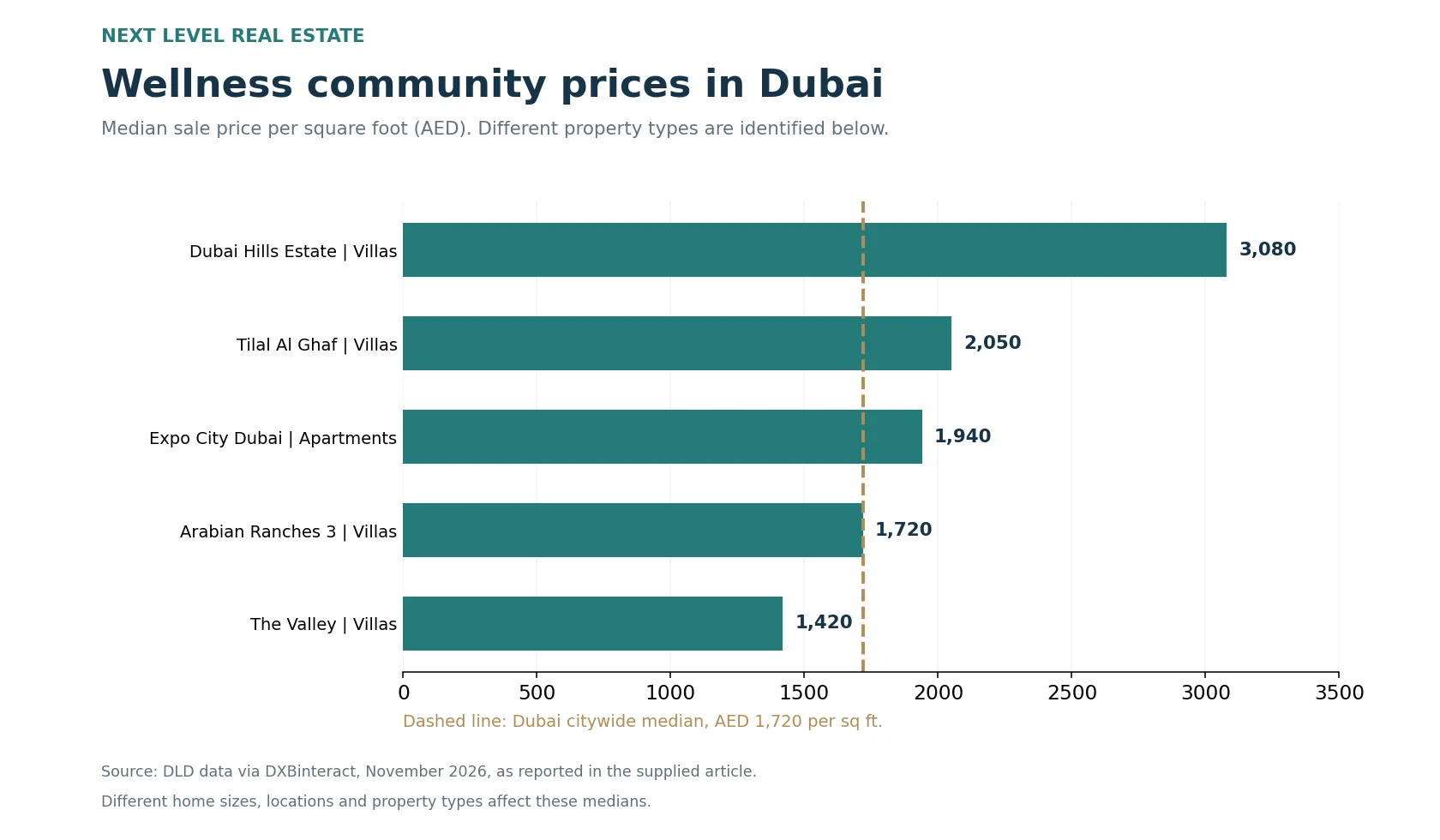
To move beyond marketing claims, we pulled the latest Dubai Land Department (DLD) registered transaction data compiled by DXBinteract (retrieved November 2026). For context, Dubai recorded about 135,400 residential and commercial sales from January to October 2026, at a citywide median of roughly AED 1,720 per square foot.
| Community | Property type | Median sale price (AED) | Median price per sq ft (AED) | Median annual rent (AED) | Implied gross yield |
|---|---|---|---|---|---|
| Dubai Hills Estate | Villas | 14,675,000 | 3,080 | 480,000 | About 3.3% |
| Tilal Al Ghaf | Villas | 9,150,000 | 2,050 | 340,000 | About 3.7% |
| Arabian Ranches 3 | Villas | 7,500,000 | 1,720 | 320,000 | About 4.3% |
| The Valley | Villas | 7,170,000 | 1,420 | 370,000 | About 5.2% |
| Dubai Hills Estate | Apartments | 2,150,000 | 2,340 | 114,000 | About 5.3% |
| Expo City Dubai | Apartments | 2,559,000 | 1,940 | 75,000 | About 2.9% |
Implied gross yield is median annual rent divided by median sale price. Medians mix different unit sizes, so treat these as a comparison guide rather than a valuation for a specific home.
How to read this table:
Mature wellness villas trade at a clear premium. Dubai Hills Estate villas sell at about AED 3,080 per sq ft, well above the citywide median, which is consistent with GWI's finding of a 10 to 25% premium for proven wellness communities.
Premium location compresses yield. The most established villa communities return around 3 to 4% gross, so they suit buyers focused on lifestyle and long-term capital value more than income.
Newer suburbs offer more yield per dirham. The Valley's lower entry price per sq ft and solid rents produce a higher implied yield, with more room for capital growth as the community matures.
Apartments are the income play. Dubai Hills Estate apartments combine wellness amenities with an implied yield above 5%, while newer districts such as Expo City Dubai have thinner rental histories that will deepen as more homes hand over.
| Factor | Wellness-led community | Conventional development |
|---|---|---|
| Purchase price | Typically 10 to 25% higher in the middle and upper market (GWI) | Lower entry price |
| Tenant profile | Families and long-stay professionals, often longer leases | Broader mix, higher turnover in some areas |
| Resale demand | Supported by end users who buy for lifestyle | More sensitive to investor sentiment |
| Running costs | Higher service charges for parks, lagoons and facilities | Usually lower service charges |
| Future-proofing | Aligned with Dubai 2040 and green building direction | Risk of looking dated as standards rise |
| Gross yield | Often lower for villas, competitive for apartments | Can be higher in dense, high-demand areas |
Wellness washing: a yoga deck and a few planters do not make a wellness community. Ask what share of the masterplan is open space, how far the nearest park, school and clinic are on foot, and what air and water systems are specified inside the home.
Service charges: lagoons, forests and large parks cost money to maintain. Check the DLD service charge index for the community, or the developer's estimate for an off-plan project, before you compare yields.
Off-plan delivery risk: a wellness masterplan delivered in phases over many years means the amenities you are paying for may arrive after handover. Our article on what to do about off-plan delays covers how to protect yourself.
Supply: with more than 555,000 wellness-focused units planned across the UAE and Saudi Arabia, the label alone will not guarantee scarcity. Location, developer track record and execution quality will separate winners from the rest.
Start with the masterplan, not the unit. Open space, walkability and community facilities drive long-term value. Our guide on why the master plan matters in off-plan investment explains what to look for.
Check the developer's delivery record. Look at completed communities by the same developer and how their amenities have aged.
Verify the in-home specification. Ask for the air filtration, water treatment, glazing and materials specification in writing.
Measure daily life. Time the walk to the nearest park, school, clinic and supermarket. This is the "20-minute city" test applied to your own home.
Compare real numbers. Use DLD transaction data for price per sq ft and rents, and include service charges in your yield calculation.
Think about the exit. Communities with strong end-user demand, schools and healthcare tend to resell faster.
Use the residency benefit. Property worth AED 2 million or more can qualify for a UAE Golden Visa. See our guide on getting a 10-year Golden Visa through off-plan property.
GWI's latest research points to a few shifts that are already visible in Dubai's new launches:
From amenity to baseline. GWI expects health-supportive design to become a standard expectation rather than a premium feature. Over time, homes without it will be the ones that trade at a discount.
Design that calms the nervous system. Natural materials, softer lighting, biophilic design and neuroscience-informed layouts are moving from hotels into homes.
Healthier materials. Developers are starting to replace synthetic finishes with stone, wool and solid wood to reduce microplastics and indoor pollutants.
Longevity and ageing well. Walkable, multigenerational communities with healthcare on site are a growing focus as long-term residents and retirees stay in Dubai.
Wellness at more price points. Apartment-led projects such as Ghaf Woods show that wellness design is moving into the mid-market, which widens the pool of buyers and tenants.
Our view at Next Level Real Estate: the strongest long-term opportunities sit where three things overlap. A proven developer, a community with real open space and walkable services, and a location that benefits from Dubai's public investment in parks and transit. Where all three are present, the wellness premium is backed by daily experience, not just a brochure.
Wellness real estate is housing and buildings proactively designed to support the physical, mental and social health of residents. It covers air and water quality, daylight, healthy materials, green space, walkability and community facilities, planned into a project from the start rather than added later.
The Global Wellness Institute forecasts the global wellness real estate market will reach $1.8 trillion by 2030, up from $876 billion in 2025. It expects the market to pass $1 trillion for the first time in 2027.
GWI estimates the UAE wellness real estate market at about $14.6 billion in 2025, up from $3.3 billion in 2017. Across the UAE and Saudi Arabia, wellness real estate represents more than 12% of all construction.
Leading wellness-led communities in Dubai include Dubai Hills Estate, Sobha Hartland in MBR City, Tilal Al Ghaf, Ghaf Woods, Expo City Dubai, Keturah Reserve, The Valley and Arabian Ranches 3. The right choice depends on budget, property type and whether you are buying to live or to rent out.
Usually, yes. GWI research finds that wellness-focused homes at the middle and upper ends of the market command a 10 to 25% price premium. In Dubai, established wellness communities such as Dubai Hills Estate trade well above the citywide median price per square foot.
It can be, if the wellness features are real and the location is strong. Wellness communities attract end users and long-stay tenants, which supports resale demand. Villa yields in premium communities are often around 3 to 4% gross, so investors focused on income may prefer apartments or newer suburbs with lower entry prices.
Look for filtered fresh air, purified water, strong natural light, good acoustic insulation and low-toxicity materials inside the home. At community level, look for parks, shaded walking and cycling routes, sports facilities, and schools, clinics and shops within a short walk.
Yes. Foreign nationals can buy freehold property in Dubai's designated freehold areas, which include the major master-planned wellness communities. Buyers investing AED 2 million or more in property may also qualify for a 10-year UAE Golden Visa.
Off-plan gives buyers access to the newest wellness designs, payment plans and launch pricing. The trade-off is delivery risk, especially for large masterplans built in phases, so check the developer's track record and the escrow and handover terms before committing.
The Dubai 2040 Urban Master Plan aims to double green and recreational space, and the Dubai Quality of Life Strategy 2033 includes more than 200 projects, a 20-minute city goal and an expansion of public parks from 23 to 64 square kilometres.
Wellness real estate has moved from a niche to the fastest growing part of the property market, on course for $1.8 trillion globally by 2030. Dubai sits at the centre of the regional story, backed by government strategy, developer investment and buyers who now judge a home by how it makes them feel and live. The opportunity is strongest in communities where wellness is built into the masterplan and proven by delivery.
If you are comparing wellness communities in Dubai, the Next Level Real Estate team can share current listings, recent transaction data and an honest view of which projects deliver on their promises. Speak to one of our property consultants to shortlist the right home or investment for your goals.
Get the latest property updates.
Amid global economic instability, Dubai’s real estate market shows remarkable resilience, defying global trends of stagnation. Strong investor confidence, a stable eco
2025-04-15
Continue Reading
Dubai’s real estate market sustained a strong performance in the first quarter of 2025, continuing the upward momentum seen throughout 2024. The marke
2025-04-17
Continue Reading
In real estate, infrastructure impact refers to the influence of physical and organizational structures—such as transportation networks, utilities, and communication s
2025-06-05
Continue Reading
In 2025, Dubai will have surpassed the United States in the number of skyscrapers. With its rapid development and iconic structures, the city has become a global leade
2025-07-18
Continue Reading
Dubai’s real estate market reached spectacular heights in July 2025, with total property transaction value soaring to AED 49.67 billion across
2025-08-08
Continue Reading