

Explore Off-Plan Projects
Stay in the loop Through our newsletter
Get to know about the latest real estate insights.

Next Level © 2026 All Right Reserved
Stay in the loop Through our newsletter
Get to know about the latest real estate insights.
Next Level © 2026 All Right Reserved
A good real estate agent in Dubai combines verified professional registration, knowledge of the exact community, transparent costs and evidence behind every recommendation. The clearest sign is practical: you understand why a property fits your needs, what could go wrong and what happens next before you commit.
Whether you are buying a family home, selling a villa or investing from overseas, good service should leave a paper trail. This guide explains the behaviours, documents and questions that help you recognise it.
| Quality | Evidence To Request | Warning Sign |
|---|---|---|
| Professional accountability | Broker details matching official DLD records and the named brokerage | Unverifiable credentials or unclear affiliation |
| Community knowledge | Recent comparable transactions and an explanation of unit differences | Citywide averages presented as a unit valuation |
| Cost transparency | Written acquisition costs and recurring expenses | Only the booking amount is discussed |
| Honest advice | Both advantages and reasons the property may be unsuitable | Every option is described as a guaranteed investment |
| Transaction management | Responsibilities, dependencies and next steps in writing | No clear owner for documents or delays |
Start by confirming who you are dealing with. Ask for the agent’s broker registration details, brokerage name and official business contact information. Match those details against the Dubai Land Department’s Licensed Real Estate Brokers service, available through its website and Dubai REST app.
Registration establishes a professional baseline. It does not prove that someone understands your preferred tower, can price your villa accurately or will manage your transaction well. Those abilities need separate evidence.
For advertised properties, ask for the relevant advertising permit details and confirm that the advertised unit, price and availability match what you are being offered. A good agent welcomes verification before asking you to make a financial commitment.
A useful first conversation covers your purpose, total available cash, financing position, timing and essential requirements. For a family, that could include school journeys, usable bedrooms, parking and the daily commute. For an investor, it includes the holding period, income needs and tolerance for vacancy or construction delays.
A good agent distinguishes your property budget from your total cash requirement. They ask what you can comfortably spend after transaction costs and leave room for expenses after purchase.
Expect a written summary of your priorities. If the shortlist repeatedly ignores your budget or move-in date, responsiveness alone is not delivering value.
Dubai Marina, JVC, Dubai Hills Estate and Palm Jumeirah contain very different buildings, layouts and buyer markets. Even neighbouring units can differ because of floor level, view, condition, tenancy or service charges.
Ask the agent to explain a small set of recent comparable transactions. Each comparison should identify the date, property size, condition and the reason it is relevant. Asking prices show seller expectations; completed transactions provide a different kind of pricing evidence.
An agent should also explain what the data cannot establish. A sale with a different view or a long-standing tenant may be a weak comparison. Thin transaction evidence should lead to a cautious valuation range.
For more detail on the underlying assessment, read our property valuation guide for Dubai investors.
Ask: “Why does this unit cost more than a similar property nearby, and what evidence supports the premium?” A strong answer connects the difference to measurable features and recent market activity. “This area is booming” does not explain the unit’s value.
A transparent agent gives you a cost breakdown before you sign. It should separate the property price, applicable registration costs, brokerage commission, financing expenses and recurring ownership costs. It should identify which figures are confirmed and which still require a quotation.
Dubai Land Department’s official FAQs explain that brokerage commission is determined by agreement, with prevailing custom used where the agreement does not specify it. Ask who pays, what the fee covers and when it becomes payable. Do not treat a quoted percentage as a universal statutory rate.
| Cost Category | What The Agent Should Clarify |
|---|---|
| Purchase and registration | Applicable charges, who pays and the payment schedule |
| Brokerage services | Agreed commission, any applicable tax, scope and payment trigger |
| Financing | Bank valuation, arrangement and registration costs confirmed with the lender |
| Building expenses | Current approved service charges, outstanding balances and maintenance needs |
| Use or letting | Furnishing, utilities, management and vacancy allowance where relevant |
The objective is a realistic cash plan. A payment plan that looks manageable at booking may create a large funding requirement at handover. Ask the agent to put the entire schedule against your available funds.
Good investment advice separates gross yield, net operating income and the cash remaining after financing. It does not promise that a rising market will eliminate property-specific risk.
Illustrative example, not market data: a property priced at AED 1,000,000 with AED 80,000 annual rent has an 8% gross yield on the purchase price. If annual operating expenses and a vacancy allowance total AED 20,000, operating income becomes AED 60,000, or 6% on that same price.
Acquisition costs increase the invested amount, while loan payments affect cash flow. The example excludes both and therefore does not represent a complete investor return. Ask the agent to show the assumptions and the outcome if rent falls or the property stays vacant longer.
A capable agent discusses likely tenant demand, competing supply, maintenance and how you would eventually sell. An attractive headline yield is only one part of the decision.
Different transactions need different skills. An agent experienced in developer launches may need support with a mortgaged resale. A leasing specialist may know tenant demand well but have limited experience coordinating a villa transfer.
| Your Situation | Evidence Of Appropriate Expertise |
|---|---|
| Ready home buyer | Unit inspection, ownership checks, tenancy review, financing dependencies and transfer coordination |
| Off plan buyer | Project registration checks, payment recipient verification, construction information and contract review coordination |
| Seller | Comparable pricing, qualified buyer screening, permitted marketing and offer management |
| Overseas investor | Live property verification, secure document handling, time zone planning and professional support |
For off plan property, ask how project registration and the correct payment account will be independently verified. Request the actual contract and written payment schedule. A showroom, brochure or computer-generated view should not be presented as evidence of the completed unit.
For a ready property, ask about the title deed, seller’s authority, occupancy, outstanding charges and any mortgage settlement. The agent should identify unresolved items and arrange the appropriate checks before you rely on the property’s availability.
Our Dubai property handover checklist explains the checks that become important when a property is ready for possession.
Good negotiation starts with a defensible position. The agent should explain comparable prices, your financing timeline, the seller’s requirements and which contract terms deserve attention.
A lower price is useful only if the agreement remains workable. Payment dates, vacant possession, inclusions and what happens if financing is delayed can matter as much as the headline figure.
A good agent does not guarantee a discount or manufacture competing offers. They distinguish a genuine deadline from sales pressure and give you enough information to decide whether proceeding makes sense.
Ask who will coordinate documents, lender communication, developer requirements and the transfer appointment. A professional agent sets an update schedule and records key decisions in writing.
When a dependency slips, the update should explain what is missing, who is responsible and how it affects the next step. An agent cannot control every approval, but they can make the status clear.
Language matters too. You should be able to understand fees, obligations and risks in the language used for the transaction. Where translation or independent legal explanation is needed, the agent should arrange appropriate support.
Ask whom the agent represents, how they are paid and whether a developer or referral arrangement influences the recommendation. If you are shown only one project, ask why alternatives were excluded.
For overseas and luxury buyers, discretion is part of service. Property documents and identity information should go only to the parties who need them through suitable channels. A broad authority to act on your behalf deserves careful independent review.
An agent should also recognise professional boundaries. Lenders decide mortgage approval, government authorities decide residency eligibility and qualified legal professionals advise on legal rights. A referral is useful; a promise on another authority’s behalf is not.
Before committing, agree what support continues after transfer or developer handover. That may include key collection, utility guidance, snagging coordination or an introduction to a property manager.
Ask which services are included and which involve a separate provider or fee. “Full after-sales support” needs a definition that both parties understand.
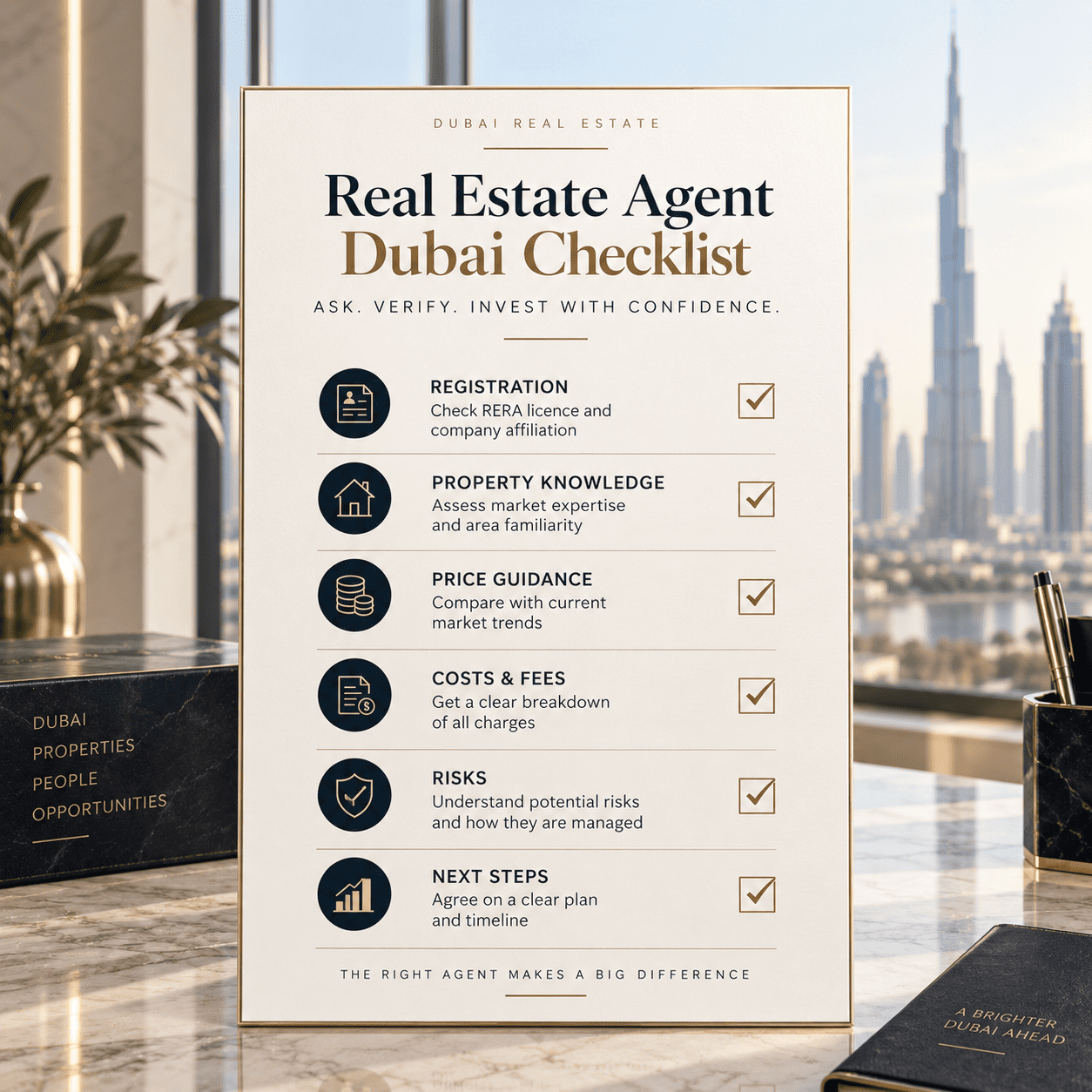
Use these questions in a consultation and ask for written follow-up where the answer affects your decision.
Planning a purchase? Ask Next Level Real Estate for a consultation based on your budget, preferred community and intended use. Request a shortlist with the pricing rationale, expected costs and principal trade-offs so you can assess the recommendation.
Pause if you cannot verify the agent, receive inconsistent property details, are discouraged from reviewing documents or are asked to pay an unexplained recipient. Preserve the advertisement, correspondence and payment instructions while you seek clarification.
A good agent should explain the payment recipient, contractual basis and receipt process. Do not let an urgent sales message replace verification. Our how to protect yourself from real estate scams in Dubai provides a separate guide to suspicious practices.
For each quality in this guide, mark the evidence as provided, pending or missing. Registration and payment verification are essential checks. An impressive personality or several positive reviews should not compensate for unresolved fundamentals.
Compare the advice itself: does the agent understand your goal, support the valuation, explain the costs and identify risks? Our guide to choosing the right agent for your real estate needs covers the wider process of shortlisting and interviewing agents.
A good agent has verifiable registration, knowledge of your community, transparent costs and evidence behind their advice. They explain risks, communicate clearly and manage agreed responsibilities throughout the transaction.
Use the Dubai Land Department Licensed Real Estate Brokers service through its website or Dubai REST app. Match the official details against the agent and brokerage you are dealing with, and clarify any discrepancy before proceeding.
Registration is a baseline professional check. Assess community knowledge, pricing evidence, service quality and transaction experience separately before deciding whether the agent fits your needs.
Ask about comparable transactions, total cash requirements, the main property risks, who the agent represents and how they are paid. Request a written summary of the shortlist rationale and next steps.
Compare the agreed fee with the services included, the quality of advice and the agent’s relevant experience. A low fee is useful when the required service and due diligence are still delivered.
An agent should distinguish forecasts from guarantees and show the assumptions behind projected returns. Market conditions, vacancy, operating expenses and resale demand can change the outcome.
Ask for project registration checks, verification of the correct payment recipient, the contract, the full payment schedule and relevant construction information. Discuss handover uncertainty, funding requirements and resale conditions.
No. Mortgage approval rests with the lender, and residency approval rests with the relevant government authority. An agent can coordinate appropriate introductions and help identify information that requires official confirmation.
Expect live verification where appropriate, clear time zone communication, suitable document handling and defined transaction responsibilities. Any authority to sign or act on your behalf should receive appropriate independent review.
Request a consultation using your budget, preferred areas, timeline and intended use. Ask for the rationale behind the shortlist, expected costs and key risks so you can evaluate the options before committing.
The qualities of a good real estate agent become visible in the work they do before you commit. Look for accurate information, a relevant shortlist, written costs, balanced recommendations and clear responsibility for the next steps.
Speak with Next Level Real Estate about your buying or selling brief. Bring your budget, timeline and priorities, and ask for advice you can compare against the checks in this guide.



Get the latest property updates.

Prorated rent is the amount you fix to a tenant for the number of days they reside in the unit, based on the monthly rent. The monthly rent is prorated by the day rather than se
2021-12-22
Continue Reading
Have you considered entering the world of real estate investment and are intrigued by the prospect of owning a 2021-12-24
Continue Reading
Renting out your property on your own is sometimes a hassle for the owners. You have to manage listings, have to attend and answer all the calls, and filter the prospects, negot
2022-01-03
Continue Reading
Dubai is one of the most breathtaking destinations in the world which offers you the top-class infrastructure and lifestyle in the metropolis. It portrays an iconic and extravag
2022-06-16
Continue Reading
When it comes to real estate, one of the key aspects that every investor should be mindful of is property valuation. Accurate property valuation not only helps you understand th
2023-09-12
Continue Reading