

Explore Off-Plan Projects
Stay in the loop Through our newsletter
Get to know about the latest real estate insights.

Next Level © 2026 All Right Reserved
Stay in the loop Through our newsletter
Get to know about the latest real estate insights.
Next Level © 2026 All Right Reserved
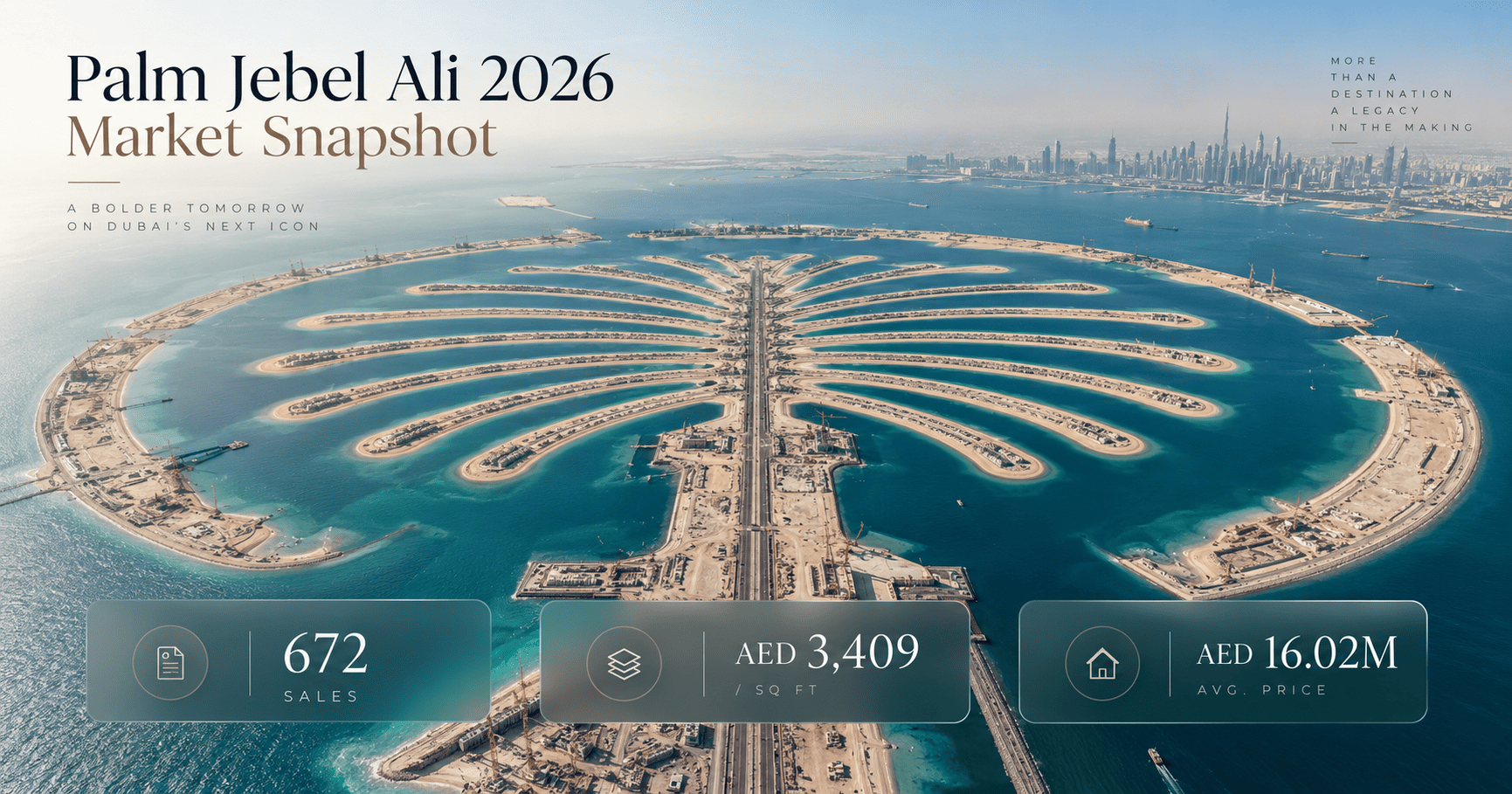
Palm Jebel Ali has quietly become one of the busiest waterfront trades in Dubai. Over the past 12 months the island recorded 672 sale transactions, up 9.3% year on year, at an average of AED 3,409 per square foot, up 22.1%. At the same time, the average deal size fell to AED 16,020,000, down 28.6%. Read only the headline numbers and that looks contradictory: prices rising and falling in the same breath. It isn't a contradiction, and understanding why is the difference between reading this market correctly and misreading it. This guide walks through what is actually selling, where, at what price down to the bedroom count, how it compares to three other Dubai waterfront and growth areas, and whether the current numbers support buying now or waiting.
Market Overview: What the Numbers Actually Mean
The past 12 months on Palm Jebel Ali broke down to 672 registered sales worth a combined transacted value in the billions of dirhams. Three figures matter most:
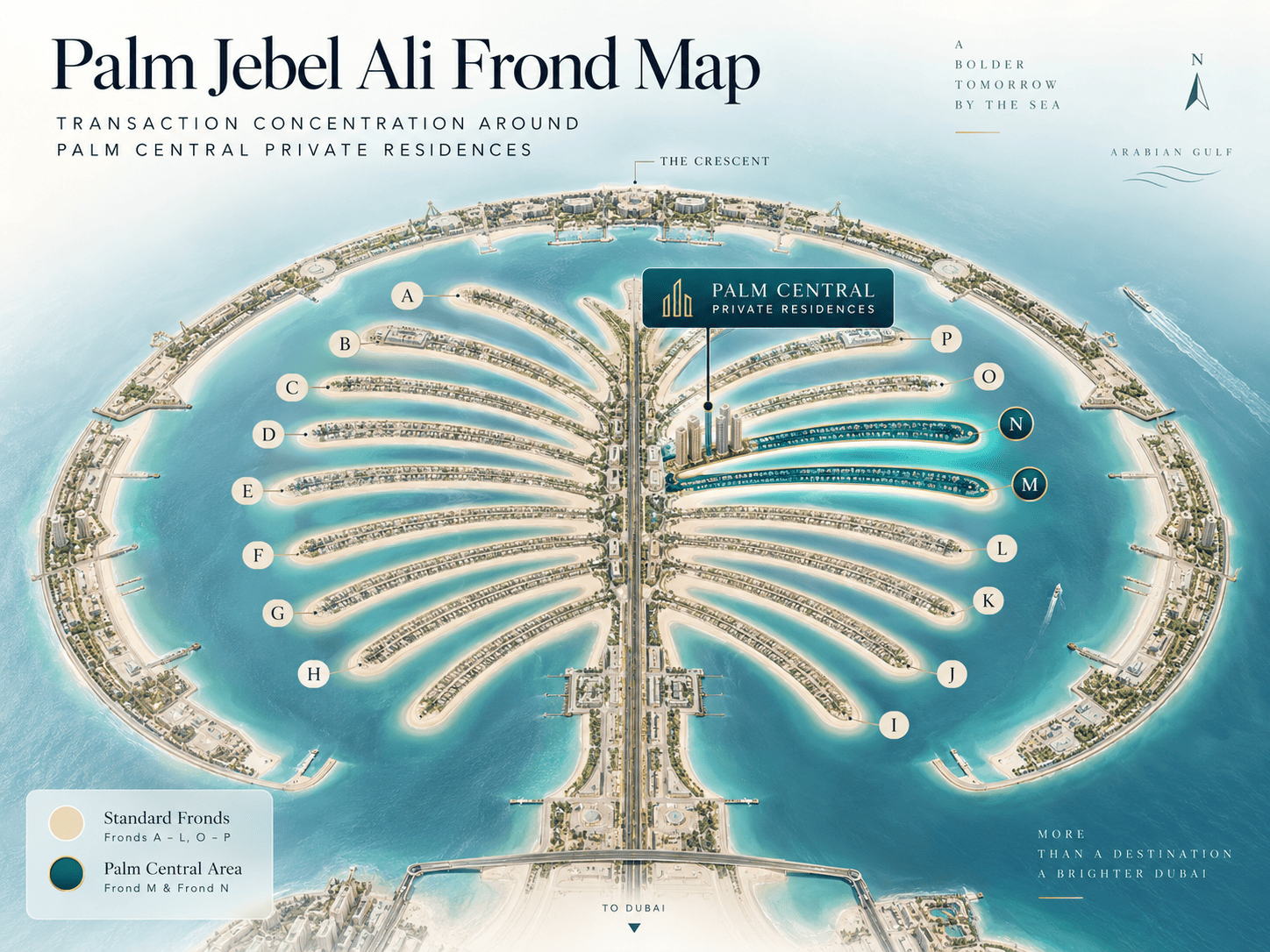
A wider Dubai Land Department cut of Palm Jebel Ali transaction data tells the same story in sharper terms: area-wide price per sq ft is up roughly 34% year on year, while the median price per unit is down more than 70% over the same period, with the area-wide median sale price currently sitting at AED 5,852,000. That gap is too large to be a pricing swing. It is a product-mix shift. A year ago, Palm Jebel Ali's headline numbers were dominated by a handful of very large legacy land parcels and beachfront villa plots, some trading in the tens of millions of dirhams. Today, the majority of transactions are smaller apartment units inside Nakheel's Palm Central Private Residences towers. More sales, smaller average ticket size, higher and rising price per square foot. That is a maturing market, not a cooling one.
Context matters here. Dubai's citywide sale market closed 2025 at an all-time high of AED 1,654 per sq ft (blended, all property types), its fifth consecutive year of growth, and 2026 is tracking a further 2.5% above that on partial-year data. Dubai Land Department figures put Q1 2026 citywide transaction value at AED 252 billion, up 31% year on year. Palm Jebel Ali's own 9.3% volume growth and 22.1% price-per-sq-ft growth are therefore happening inside a broader market that is itself at a cyclical peak, not against a falling tide, which supports reading Palm Jebel Ali's numbers as genuine local demand rather than a market-wide anomaly.
Palm Jebel Ali is not one uniform market. It is a set of Fronds at very different stages, and the sales data reflects that clearly:
| Location | Transactions (last 12 months) | Share of total sales |
|---|---|---|
| Palm Central Private Residences, Frond M | 212 | ~32% |
| Palm Central Private Residences, Frond N | 187 | ~28% |
| Frond B | 48 | ~7% |
| Frond C | 47 | ~7% |
| Frond A | 46 | ~7% |
| Frond D | 45 | ~7% |
| Frond E | 40 | ~6% |
| Frond N (villas/land) | 14 | ~2% |
| Frond M (villas/land) | 13 | ~2% |
| Frond P, L, O, F, K (combined) | 20 | ~3% |
Roughly 60% of all Palm Jebel Ali sales activity is concentrated in just two towers, Palm Central Private Residences on Fronds M and N. That concentration matters for buyers: it means the "average" island-wide price is really being set by one project type, apartments in two towers, rather than by the villa and beachfront product most marketing materials lead with. Anyone comparing prices should compare within the same Frond and product type, not against the island-wide average.
To ground the averages in real deals, here is a sample of individual Palm Central Private Residences and villa transactions registered on the island in the first week of September 2026:
| Building | Beds | Size (sq ft) | Price (AED) | Price/sq ft | Status |
|---|---|---|---|---|---|
| Frond M, Building A | 1 | 806 | 2,722,000 | 3,377 | Off-plan, primary |
| Frond M, Building B | 1 | 811 | 2,673,000 | 3,296 | Off-plan, primary |
| Frond M, Building A | 2 | 1,206 | 4,261,000 | 3,533 | Off-plan, primary |
| Frond M, Building A | 2 | 1,502 | 5,959,000 | 3,967 | Off-plan, primary |
| Frond M, Building A | 3 | 2,028 | 7,694,000 | 3,794 | Off-plan, primary |
| Frond C (villa) | 5 | 7,569 | 21,757,000 | 2,652 | Resale |
Two patterns stand out. First, price per sq ft climbs with unit size within the same building, which is typical for higher floors and better-positioned stock within an off-plan release. Second, the one resale villa in this sample, on Frond C, transacted at a noticeably lower price per sq ft than the Frond M apartments, reinforcing that villa and apartment pricing on this island should never be read as one blended figure.
Palm Jebel Ali's year-to-date sales break down by unit size as follows. The largest size bands mix legacy land and villa plots, so treat the bedroom labels on those as typical rather than exact:
| Typical unit | Size range (sq ft) | YTD volume | Median price (AED) |
|---|---|---|---|
| 1-bedroom apartment | 740 to 843 | 120 | 2,782,000 |
| 2-bedroom apartment | 1,206 to 1,843 | 110 | 4,481,500 |
| 3-bedroom apartment | 2,025 to 3,212 | 56 | 7,705,000 |
| 4-bedroom unit | 3,251 to 4,445 | 23 | 13,138,500 |
| 5-bedroom villa/plot | 4,813 to 9,796 | 34 | 23,000,000 |
| 6-bedroom villa/plot | 7,373 to 20,383 | 69 | 30,514,000 |
| 7-bedroom villa/plot | 13,098 to 20,933 | 23 | 49,314,000 |
The 1 and 2-bedroom rows are almost entirely Palm Central Private Residences stock, which is why their size bands are tight and their volumes are highest. From 4 bedrooms up, the size ranges widen sharply and volumes drop, consistent with these being villa and beachfront plot transactions rather than standardised apartment releases.
Based on ten comparable Palm Central Private Residences transactions, a 1,500 sq ft two-bedroom unit on Palm Jebel Ali carries an indicative value of about AED 5,250,000 (range AED 4,339,500 to AED 5,922,000), using a median rate of AED 3,500 per sq ft. On standard UAE mortgage terms, buying a comparable AED 4,400,000 two-bedroom unit with 20% down at 4.5% interest over 25 years works out to roughly:
These figures are indicative, not a lending offer, and assume standard 80% loan-to-value and current market interest rates. Confirm actual terms with your bank before budgeting.
Since Palm Central Private Residences drives the majority of current sales, its building-level numbers are the most useful benchmark on the island:
All three buildings are developed by Nakheel, the project's master developer, and are scheduled for handover in mid-2029. Unit mix across the buildings runs from one to five bedrooms, with two and three-bedroom layouts making up the largest share of inventory. Beyond the apartment towers, buyers looking at villa and beachfront plots on the outer Fronds, including Red Aurora's 7-bedroom Coral Collection villas, are buying into a different product entirely, with far lower transaction volume and correspondingly less price transparency.
Rather than compare Palm Jebel Ali to Palm Jumeirah alone, it's more useful to see it alongside two other actively developing waterfront and emerging areas: Dubai South and Dubai Islands.
| |
Palm Jebel Ali | Palm Jumeirah | Dubai South | Dubai Islands |
|---|---|---|---|---|
| Median price | AED 5,852,000 | AED 5,900,000 | AED 1,072,000 | AED 2,850,000 |
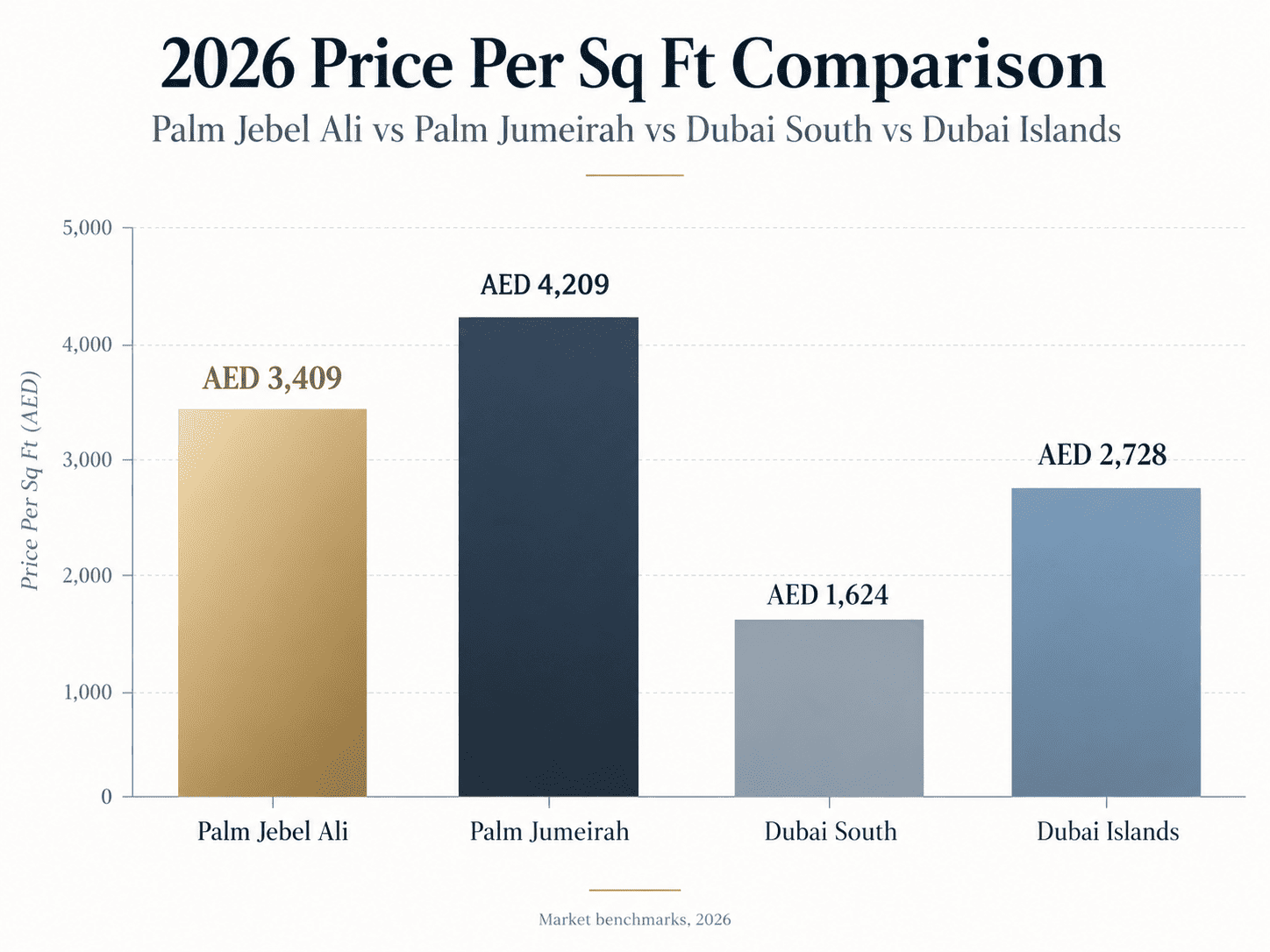
| Price per sq ft | AED 3,520 | AED 3,730 | AED 1,640 | AED 2,710 |
| 12-month sales volume | 543 | 1,329 | 16,191 | 5,270 |
| Gross rental yield | Not yet reliable | 6% | 8% | 4% |
| Capital appreciation (12m) | 0% | 14% | 7% | 0% |
Two things jump out. First, on a blended, all-property basis Palm Jebel Ali and Palm Jumeirah are closer in price per sq ft (AED 3,520 vs AED 3,730) than the "60% cheaper" framing used elsewhere on the web, which typically compares Palm Jebel Ali's lowest-priced villas against Palm Jumeirah's highest-priced ones. Second, Palm Jebel Ali is the only one of the four areas with high pricing but no established yield or appreciation data yet, which is exactly what you'd expect from a market that is still mostly pre-handover. Dubai South and Dubai Islands, both further along in delivering completed, tenanted stock, already show measurable yield and appreciation.
Palm Jebel Ali's own rental yield data is too thin to quote honestly, since most of the actively trading stock hasn't handed over, so there isn't a meaningful base of tenanted units to calculate from. Rather than invent a number, it's more useful to look at what happens to a "headline" yield once you apply it to today's actual median price. Palm Jumeirah is often quoted at a 6% market reference yield. Run that against its current median sale price of AED 5,900,000 and current median rent, and the real gross yield on a median-priced unit today comes out closer to 3.2%, with a simple payback period of roughly 31 years before service charges, fees, vacancy, and financing costs. That gap between the quoted "market" yield and the yield an actual buyer earns at median pricing is worth remembering before anyone quotes you a headline number for Palm Jebel Ali once it has rental data of its own.
The investment case for Palm Jebel Ali rests on price positioning and momentum rather than proven yield, at least for now. Waterfront apartments here trade close to comparable Palm Jumeirah stock on a per-sq-ft basis while carrying materially lower absolute entry prices at the one and two-bedroom level, and demand is broad-based rather than concentrated in a handful of large deals: 672 transactions across a full 12-month window, not a short-lived spike. That combination is the core of the "buy now" argument for buyers focused on capital entry point rather than near-term income.
Three things temper the bull case, and a serious buyer should weigh all three before committing:
None of this makes Palm Jebel Ali a bad buy. It makes it a buy that suits patient, long-horizon capital more than investors chasing near-term rental income.
The two figures move in opposite directions because the mix of what is selling has changed, not because value is falling. A year ago, sales were dominated by a small number of very large, very expensive land and villa deals. Today, the bulk of transactions are smaller Palm Central Private Residences apartment units on Fronds M and N. More, smaller-ticket sales pull the average deal size down even while the underlying price per square foot keeps climbing.
Palm Jebel Ali offers waterfront pricing close to, and in most product tiers below, Palm Jumeirah, with rising price-per-sq-ft momentum and demand that has grown 9.3% year on year even as Dubai's citywide market sits at an all-time high. The trade-off is a multi-year wait to handover on most units and a market still too young for reliable rental yield data, so it suits patient capital more than income-focused investors right now.
Frond M and Frond N carry the most transaction volume by a wide margin, driven almost entirely by the Palm Central Private Residences apartment towers. Together they account for well over half of all Palm Jebel Ali sales in the past 12 months, with the remaining Fronds trading in much smaller numbers of villa and land deals.
Nakheel's Palm Central Private Residences buildings on Fronds M and N are currently scheduled for handover in mid-2029. Villa and beachfront plots on other Fronds vary by project and developer contract, so buyers should confirm the specific handover date for any unit before committing.
It depends which product you compare. On a blended, all-property basis the two islands are close, roughly AED 3,520 per sq ft on Palm Jebel Ali against AED 3,730 on Palm Jumeirah. Palm Jebel Ali's apartment stock in Palm Central Private Residences trades at a real discount to Palm Jumeirah's higher-end villas and branded residences, but it is not the blanket 60 percent gap sometimes quoted, since that figure compares Palm Jebel Ali's cheapest villas to Palm Jumeirah's most expensive ones.
Two-bedroom units in Palm Central Private Residences typically run 1,206 to 1,843 sq ft with a year-to-date median price of about AED 4,481,500, roughly AED 3,300 to 3,700 per sq ft depending on the building and floor. Recent early-September 2026 transactions in Building A priced 2-bedroom units between AED 4,261,000 and AED 5,959,000.
There is no reliable rental yield figure for Palm Jebel Ali yet, because almost none of the actively trading stock has handed over or been tenanted. As a benchmark, Palm Jumeirah's own yield on today's median sale price works out to about 3.2% gross, well below its often-quoted 6% market reference yield, which is a useful reminder that headline yield figures can overstate what a buyer at median pricing actually earns.
Palm Jebel Ali's 2026 numbers describe a market in transition, not a market in trouble. Volume is up, price per square foot is up, and the falling average deal size is simply the product mix maturing from legacy land sales toward apartment-scale living, exactly what you'd expect as a masterplan moves from paper to towers, and it's happening inside a citywide market that itself sits at an all-time high. That doesn't remove the real risks: a 2029 handover horizon, thin historical pricing data, and no proven rental yield yet. For buyers comfortable with a long hold and drawn to genuinely competitive pricing against Palm Jumeirah, the current data supports a considered entry rather than a wait-and-see approach. Browse the off-plan launches on the island or the full Palm Jebel Ali area guide to see current availability, and for context on how far the market has come, our earlier coverage of an earlier AED 5.4 billion sales milestone is worth a read.

Get the latest property updates.
Prorated rent is the amount you fix to a tenant for the number of days they reside in the unit, based on the monthly rent. The monthly rent is prorated by the day rather than se
2021-12-22
Continue Reading
Have you considered entering the world of real estate investment and are intrigued by the prospect of owning a 2021-12-24
Continue Reading
Renting out your property on your own is sometimes a hassle for the owners. You have to manage listings, have to attend and answer all the calls, and filter the prospects, negot
2022-01-03
Continue Reading
Dubai is one of the most breathtaking destinations in the world which offers you the top-class infrastructure and lifestyle in the metropolis. It portrays an iconic and extravag
2022-06-16
Continue Reading
When it comes to real estate, one of the key aspects that every investor should be mindful of is property valuation. Accurate property valuation not only helps you understand th
2023-09-12
Continue Reading