

Explore Off-Plan Projects
Stay in the loop Through our newsletter
Get to know about the latest real estate insights.

Next Level © 2026 All Right Reserved
Stay in the loop Through our newsletter
Get to know about the latest real estate insights.
Next Level © 2026 All Right Reserved
No tags available
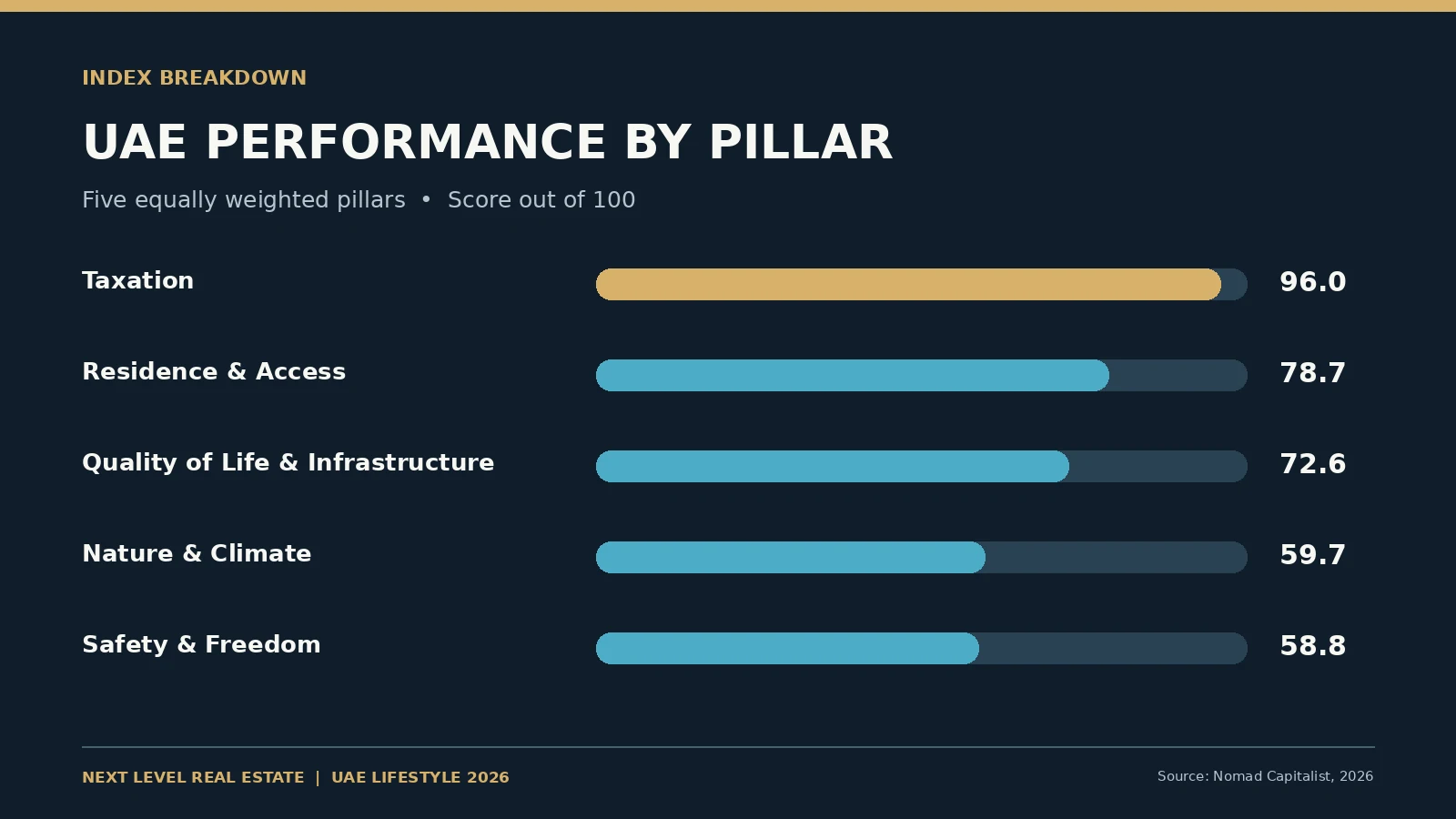
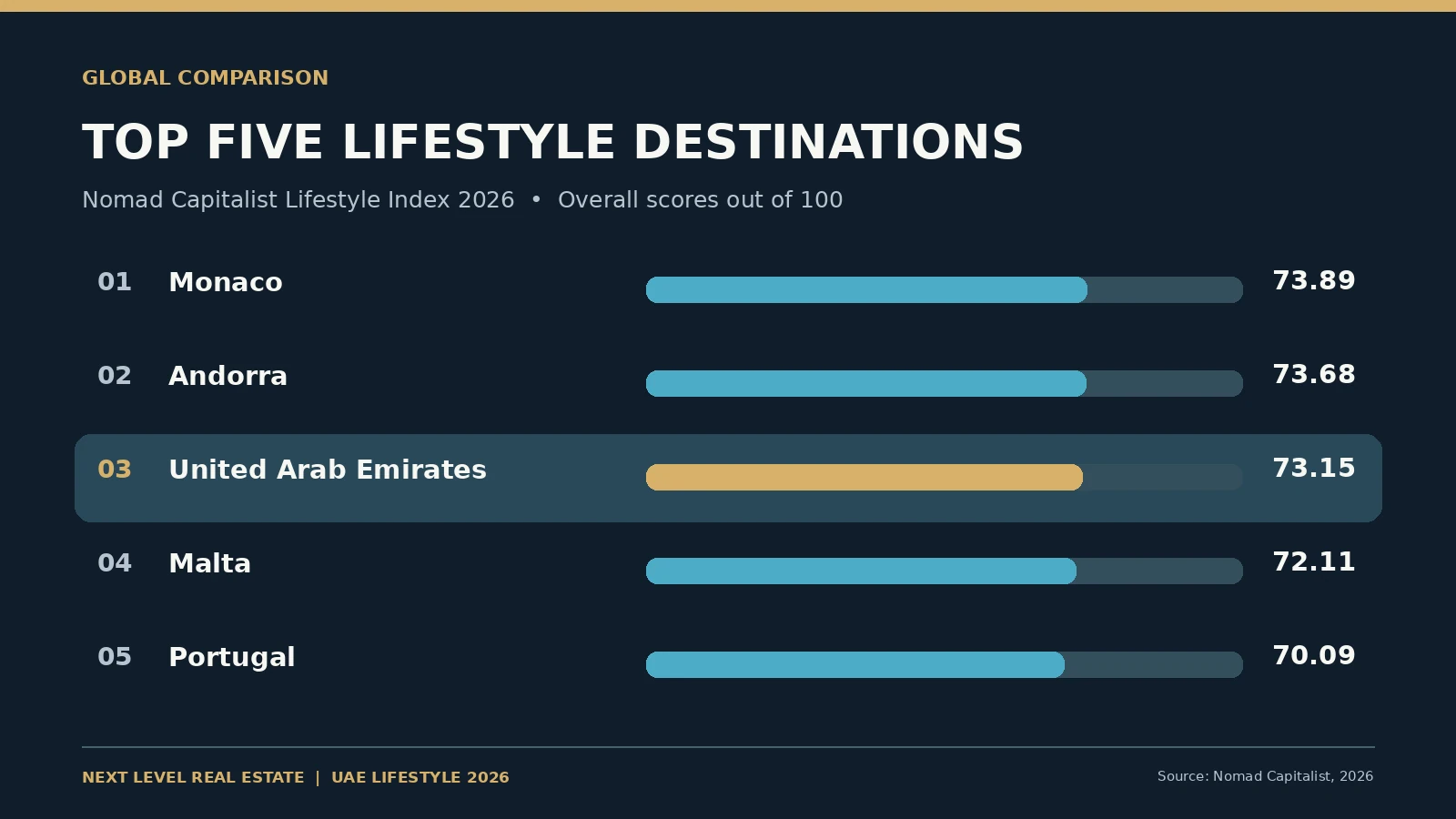
The UAE ranked third out of 63 destinations in the Nomad Capitalist Lifestyle Index 2026, scoring 73.15 out of 100, just 0.74 points behind Monaco (73.89) and 0.53 points behind Andorra (73.68). It was the only Gulf country in the index and took first place worldwide for taxation with a score of 96, while also ranking 5th for quality of life and infrastructure and 3rd for residency and accessibility. For anyone weighing a move, a second home or a property investment, the result confirms what the data has been saying all year: the UAE now competes with Europe's most established lifestyle destinations, and it does so at a scale and price point those microstates cannot match.
Below, we break down how the index works, where the UAE scored well and where it did not, how the result lines up with other 2026 rankings, and what it means in practical terms for people choosing where to live and buy in Dubai and Abu Dhabi.
The Lifestyle Index is a new ranking published in October 2026 by Nomad Capitalist, a consultancy that advises internationally mobile entrepreneurs and investors on residency, citizenship and tax. Rather than rating how existing residents feel, it measures what a globally mobile person can realistically access in each destination, looking beyond salaries and living costs.
Each of the 63 destinations is scored on five equally weighted pillars, each worth 20% of the final result:
The top three finished less than one point apart, and Khatia Gelbakhiani, Head of Product at Nomad Capitalist, described the result as "a shortlist, not a podium." Each leader won on a different pillar: Monaco on quality of life, Andorra on safety and freedom, and the UAE on tax. In other words, the "best" choice among the three depends on which pillar matters most to you.
| Rank | Destination | Overall Score (out of 100) |
|---|---|---|
| 1 | Monaco | 73.89 |
| 2 | Andorra | 73.68 |
| 3 | United Arab Emirates | 73.15 |
| 4 | Malta | 72.11 |
| 5 | Portugal | 70.09 |
| 6 | Cyprus | 68.42 |
| 7 | Singapore | 67.12 |
| 8 | Cayman Islands | 66.50 |
| 9 | New Zealand | 66.43 |
| 10 | Switzerland | 65.44 |
Two points stand out. First, the UAE is the only destination in the top three with a large, diversified economy and a deep property market; Monaco and Andorra are microstates with very limited housing stock and some of the highest entry prices in the world. Second, the UAE outranked Singapore and Switzerland, two destinations that are often treated as the benchmark for safety, services and wealth management. It also led the Middle East, Africa and Indian Ocean group, ahead of Seychelles (12th) and Mauritius (17th).
| Pillar | UAE Score (out of 100) | Global Rank (of 63) | What It Means for Residents |
|---|---|---|---|
| Taxation | 96.0 | 1st | No personal income tax and no capital gains tax on individuals |
| Residency and accessibility | 78.7 | 3rd | Clear long-term visa routes, including the 10-year Golden Visa |
| Quality of life and infrastructure | 72.6 | 5th | Modern transport, healthcare, connectivity and services |
| Nature and climate | 59.7 | 16th | Excellent winters, very hot summers |
| Safety and freedom | 58.8 (reported) | Not published | Very high personal safety; freedom indicators weigh on the score |
The UAE's tax score was the highest of all 63 destinations, ahead of long-standing low-tax jurisdictions such as Monaco, Andorra and the Cayman Islands. Individuals pay no personal income tax and no capital gains tax, and the federal corporate tax introduced in June 2023 generally applies at 9% to taxable business income above AED 375,000, which remains low by international standards. For property owners, there is no annual property tax on residential homes in Dubai; the main costs are the one-time 4% Dubai Land Department transfer fee and ongoing service charges. Our guide to property taxes and fees for Dubai buyers sets out each cost in detail.
What it means for buyers: rental income and resale gains from a Dubai property are not taxed locally at the personal level, so a gross yield of around 7% converts into a far higher net return than the same yield would in most European markets. Investors should still check their tax position in their home country.
The UAE's residency score reflects a deliberate policy shift over the past few years. The 10-year Golden Visa, expanded in 2022 to cover investors, skilled professionals and entrepreneurs, gives long-term security that was previously unavailable to most expatriates. Property is one of the simplest routes: a property investment of at least AED 2 million may qualify, subject to authority conditions. Off-plan purchases must meet approved-developer requirements; mortgaged purchases require bank documentation and applicable paid-amount conditions. Alongside this sit remote work, retirement and freelance routes, which together make the UAE one of the most accessible countries for people who want to relocate on their own terms.
Fifth place globally places the UAE ahead of most of Europe on everyday infrastructure. Dubai's metro and road network, Dubai International, one of the world's busiest international airports, near-universal high-speed connectivity and a large private healthcare and education sector all feed into this score. Henley & Partners reached a similar conclusion in its 2026 report, placing the UAE alongside Australia, Canada, New Zealand and Switzerland at the top for quality of life. The link between this infrastructure and property values is direct, as we explain in our analysis of how Dubai's infrastructure shapes property values.
Nature and climate is one of the UAE's lower-scoring pillars. The publisher highlights air quality as an important constraint. Summers from June to September are extremely hot and humid, which limits outdoor life for several months. The flip side is a mild, sunny winter season from November to March that is among the most attractive in the world, along with long coastlines, desert landscapes and the mountains of Hatta and Ras Al Khaimah. Many residents structure their year around this, travelling in summer and spending the cooler months at home.
Nomad Capitalist did not publish a rank for the UAE on this pillar, and the reported score of 58.8 is its lowest pillar score. This needs context. The pillar blends personal safety with civil and economic freedom measures, and the freedom side pulls the UAE's figure down. On personal safety alone, the UAE leads the world: Numbeo's January 2026 Safety Index named it the safest country globally for the second year in a row, Abu Dhabi held the title of the world's safest city for the 10th consecutive year, and Dubai ranked 6th among roughly 400 cities. Residents considering a move can read our article on whether Dubai is safe for women living alone for a practical perspective.
One index on its own can reflect a particular methodology. What makes the Lifestyle Index result credible is how closely it matches other independent rankings published during 2026:
| Ranking (2026) | Publisher | UAE Result | What It Measures |
|---|---|---|---|
| Lifestyle Index | Nomad Capitalist (October) | 3rd of 63; 1st for tax | Tax, residency, safety, climate and quality of life for mobile individuals |
| Global Residence Program Index | Henley & Partners (February) | Joint 2nd (score 72), up from 5th | Quality of 40 investor residence programmes |
| Expat Insider | InterNations | 4th overall; 1st for Expat Essentials; 1st for career prospects | How expatriates rate life in their host country |
| Safety Index by Country | Numbeo (January) | 1st, second year running | Perceived personal safety and crime levels |
| Safety Index by City (mid-year) | Numbeo | 5 UAE cities in the global top 6 | City-level safety perception |
The pattern is consistent. Whether the lens is tax, residency programmes, expatriate experience or safety, the UAE now sits in or close to the global top three. That consistency matters to investors because it signals durable demand rather than a short-term marketing story. It also explains why wealthy people from around the world choose to live in Dubai.
Lifestyle rankings matter to property markets for one reason: they influence where people choose to move, and people need homes. Here is how that is showing up in the 2026 data.
Dubai's population reached 4.58 million at the end of 2025, an increase of around 332,000 residents or 7.5% in a single year, according to the Dubai Data and Statistics Establishment. By September 2026 it had reached 4,807,185, adding 226,885 people since January. Growth was not uninterrupted: the population fell by roughly 61,000 in March 2026 during the height of the regional conflict with Iran, before recovering to new highs by the end of June. For property owners, the recovery is the more important signal. Within three months, net inflows had returned, which suggests that the lifestyle factors drawing people to the UAE outweigh short-term disruption for most movers.
Dubai Land Department data shows total real estate transactions of AED 252 billion in Q1 2026, up 31% year on year, with foreign investment rising 26% to AED 148.35 billion. From January to October 2026, transactions reached about AED 624.8 billion across 181,866 deals, of which roughly AED 412 billion were sales. Sales in the first nine months, at around AED 380 billion, were below the record set in the same period of 2025 (AED 495.8 billion) but still the second highest on record. In short, the market has moved from exceptional growth to a high, more measured plateau. For a monthly view, see our Dubai real estate market performance report for July 2026.
The communities that best reflect the UAE's lifestyle strengths, from waterfront living to walkable city districts, continue to deliver solid rental returns. The table below uses 2026 year-to-date medians from Dubai Land Department registrations, covering all property types and bedroom counts.
| Area | Median Annual Rent (AED, 2026) | Median Gross Yield (2026) | Lifestyle Profile |
|---|---|---|---|
| Dubai (citywide) | 64,000 | 7% | Full market average |
| Downtown Dubai | 148,000 | 7% | Landmark urban living around Burj Khalifa |
| Business Bay | 100,000 | 7% | Canal-side business and residential hub |
| Dubai Marina | 120,000 | 6% | Waterfront towers, beach and marina walk |
| Palm Jumeirah | 180,000 | 6% | Island villas and beachfront apartments |
| Mirdif | 88,000 | 7% | Established family villa district |
What this data means for investors: a gross yield of 6% to 7% in prime and mid-market locations, with no personal tax on the income, compares very favourably with Monaco, Andorra, Malta or Portugal, where yields are typically lower and rental income is taxed. Buyers should, however, budget for service charges, maintenance and void periods, which reduce gross yield to a lower net figure.
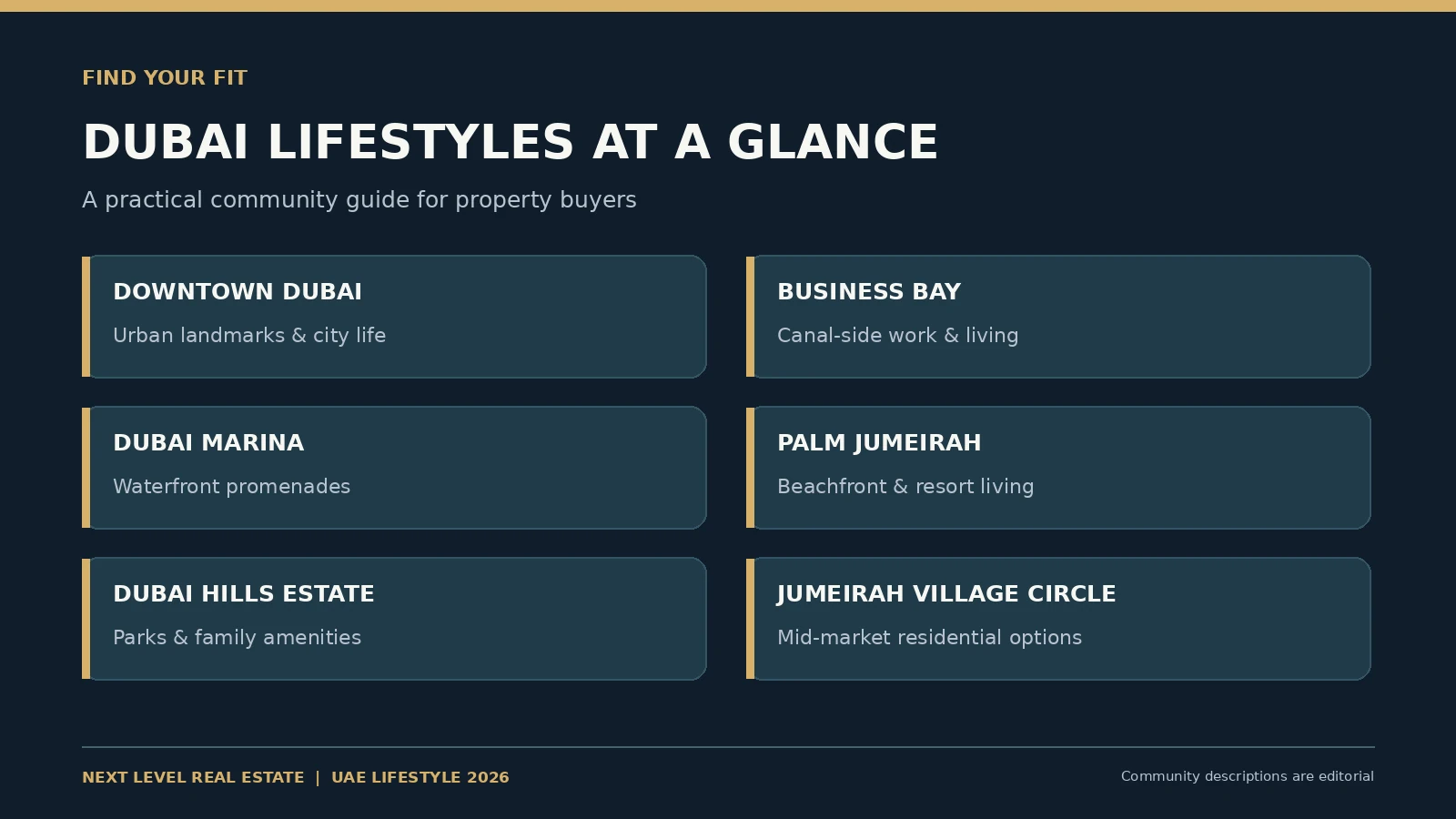
The Lifestyle Index rewards the UAE as a whole, but the experience of living here varies widely by community. Matching the area to your priorities is the most important decision you will make. For a broader overview, see our guide to the best places for expats to live in Dubai.
Downtown Dubai and Business Bay offer the most city-like experience in the UAE, with restaurants, offices, retail and the Dubai Water Canal on your doorstep. Residents who want an address close to the Burj Khalifa can explore properties for sale in Downtown Dubai, while those looking for newer stock and flexible payment plans often consider off-plan projects in Business Bay.
Waterfront communities capture the UAE's winter climate at its best. Palm Jumeirah remains the flagship address for high-net-worth buyers, and its master developer is profiled on our Nakheel developer page. Buyers can browse villas for sale on Palm Jumeirah or, for an established tower lifestyle, apartments for sale in Dubai Marina. Dubai Creek Harbour offers a newer waterfront alternative, with off-plan apartments in Dubai Creek Harbour priced below comparable beachfront addresses.
Families tend to prioritise space, parks and schools. Dubai Hills Estate combines all three, with an 18-hole golf course, a large central park and several schools nearby; see villas for sale in Dubai Hills Estate. The community is master-planned by Emaar Properties, which is also behind newer suburban villa launches such as The Valley Phase 2 on the Al Ain Road. Parents comparing options should also review our list of the top 10 schools in Dubai.
Mid-market communities such as Jumeirah Village Circle combine lower entry prices with strong rental demand; JVC recorded more ready apartment sales than any other Dubai area in the first nine months of 2026, with 3,062 transactions. Our analysis of the most in-demand apartment sizes in Dubai in 2026 shows which unit types are moving fastest.
Abu Dhabi offers a calmer lifestyle with the same tax and residency benefits, and it is home to the world's safest city. Yas Island, developed by Aldar Properties, combines theme parks, beaches, golf and a growing residential community; see properties for sale on Yas Island.
The UAE's 3rd-place residency score is closely linked to its property-backed visa options. Here is how they compare:
| Feature | 10-Year Golden Visa (Property Route) | 2-Year Property Investor Visa |
|---|---|---|
| Minimum property value | AED 2 million (single or combined properties) | No minimum for sole owners of completed property |
| Off-plan property | May qualify through an approved developer, subject to authority requirements | Not eligible |
| Mortgaged property | Subject to DLD approval, bank documentation and paid-amount requirements | Subject to bank and Dubai Land Department conditions |
| Validity | 10 years, renewable | 2 years, renewable |
| Family sponsorship | Spouse and children | More limited |
| Minimum stay requirement | None | Standard residency rules apply |
Eligible off-plan purchases may support a residency application before handover, subject to approval and current documentation requirements. Our step-by-step guide explains how to get a 10-year Golden Visa by buying off-plan property in Dubai. Rules are updated regularly, so always confirm current requirements with the Dubai Land Department before applying. Other routes, such as the retirement visa in Dubai and the Dubai remote work visa, suit people who do not plan to buy straight away.
No ranking tells the whole story, and the UAE's third place reflects real weaknesses alongside its strengths. A balanced decision should account for the following:
For buyers comparing the UAE directly with a European alternative, our UAE vs Spain comparison of living costs, lifestyle and career opportunities offers a useful framework that also applies to Portugal, Malta and Cyprus.
Buyers who are weighing the UAE against a European residence option tend to ask the same questions. Here is the practical advice the Next Level Real Estate team gives:
The UAE ranked 3rd out of 63 destinations in the Nomad Capitalist Lifestyle Index 2026 with an overall score of 73.15 out of 100, behind Monaco (73.89) and Andorra (73.68).
Monaco ranked first with 73.89 points, followed by Andorra with 73.68. The top three, including the UAE, were separated by less than one point.
The UAE scored 96 out of 100 for tax, the highest of all 63 destinations, because individuals pay no personal income tax and no capital gains tax, while the standard corporate tax rate is 9% on taxable business income above AED 375,000. Personal investment and business activities can have different treatment.
Safety and freedom was the UAE's lowest-scoring pillar at 58.8. Nature and climate scored 59.7. The safety pillar includes freedom indicators alongside personal safety, while air quality constrains the nature pillar.
Yes. Numbeo's January 2026 Safety Index ranked the UAE as the safest country in the world for the second consecutive year, with Abu Dhabi named the world's safest city for the 10th year in a row and Dubai ranked 6th.
The UAE ranked joint 2nd in the Henley and Partners Global Residence Program Index 2026, up from 5th, and 4th in the InterNations Expat Insider 2026 survey, where it ranked 1st for expat essentials and career prospects.
Yes. Buying property worth at least AED 2 million, as a single home or a combination of properties, makes you eligible to apply for the 10-year renewable Golden Visa. Ready, off-plan and mortgaged properties can all qualify, subject to Dubai Land Department requirements.
Dubai Land Department data for 2026 shows a citywide median gross rental yield of around 7%, with Downtown Dubai and Business Bay at about 7% and Dubai Marina and Palm Jumeirah at about 6%. Net yields are lower after service charges and other costs.
Yes. Dubai's population reached 4.58 million at the end of 2025, up 7.5% in a year, and stood at 4,807,185 in September 2026 after adding 226,885 residents since January, despite a temporary dip in March 2026.
Downtown Dubai and Business Bay suit urban living, Palm Jumeirah, Dubai Marina and Dubai Creek Harbour suit waterfront living, Dubai Hills Estate suits families, and Jumeirah Village Circle offers value for first-time buyers. In Abu Dhabi, Yas Island combines leisure and residential living.
The UAE's third place in the Lifestyle Index 2026 is not an isolated headline. It is backed by first place for tax, top-five quality of life, top-ten residency access, world-leading personal safety and a population that keeps growing. The trade-offs, mainly summer heat, living costs and new supply, are real and should shape where and how you buy, but they do not change the bigger picture: the UAE now sits on the same shortlist as Monaco and Andorra, with a far larger and more accessible property market.
If you are considering a move or an investment, the Next Level Real Estate team can help you shortlist communities, compare yields and structure a purchase that qualifies for the Golden Visa. Speak to one of our advisors to start planning your next step in the UAE.
Get the latest property updates.
Abu Dhabi-based Aldar Properties today announced that it has sold out the first two phases of Dubai Haven by Aldar, its first residential development in the emirate. The develop
2023-11-02
Continue Reading
The real estate market in Dubai has witnessed a new milestone with the astonishing sales figures from Palm Jebel Ali, the latest addition to Dubai's iconic island developments.
2023-11-15
Continue Reading
In a landmark announcement, Sheikh Mohammed bin Rashid, Vice President and Ruler of Dubai, revealed a comprehensive set of 10 economic principles that will shape the trajectory
2023-11-29
Continue Reading
Despite the year-end holiday season, Dubai's vibrant property market closed out 2023 with a bang, demonstrating remarkable resilience and adaptability in December. Characterized
2023-12-22
Continue Reading
The United Arab Emirates (UAE) has emerged as a major player in global residential investment, marking its territory in the top 10 of Housearch's Investment Index for 20
2024-01-09
Continue Reading